Showing posts with label shallots. Show all posts

Thursday, August 30, 2012

Lemon and Kale Inspiration Brightens Up My Leftovers

Kimberly Wilson, the founder of my yoga studio and home away from home, Tranquil Space, has a wonderful blog called Tranquility du Jour.  Recently, she added a new feature to her blog, Meatless Mondays, that features a vegetarian friendly dish every, well, Monday.

This Monday's recipe was Kale + Quinoa Pilaf, which looked scrumptious.  Since I've been promising my husband to make better use of our leftovers, I decided to incorporate the flavors from the pilaf into a dish that used the farro I made earlier this week.

First, I made a dressing with one finely chopped shallot bulb, the juice of half a lemon, two tablespoons of olive oil, freshly ground black pepper and sea salt.  Next, I chiffonaded some tuscan kale into ribbons.  Once the kale was ready, I put the farro in the microwave for one minute to warm it, stirred in the kale, and microwaved it for another minute.  I then poured the dressing over the hot kale and farro and stirred it well until it was well combined and I could smell the lemon.

The lemon and olive oil dressing is extremely simple and makes a huge difference in flavor!  It's bright, crisp and light, and made our whole kitchen smell like lemony goodness.  Husband ate and enjoyed as well.  Note to self - use lemon and olive oil dressings more often!

This dish is a great example of how you don't need a ton of time to prepare a healthy meal.  It took a whopping five minutes to put together.  Having the some farro pre-cooked definitely helped, but if I had made this with quinoa, it wouldn't have taken much longer.

Sunday, December 18, 2011

Quinoa Pasta with Quorn, Brussels Sprouts and Carrots

Since I know so many folks with gluten intolerance, I like to play around with various gluten free pastas.  Also, since I don't like to eat a lot of things made with refined white flour, I find that some of these pastas are good options in lieu of traditional boxed pasta.

Tonight, I decided to play with Ancient Harvest's Quinoa Shells.  The shells are actually a blend of quinoa and corn.  They're a little brighter yellow than your average pasta, but otherwise, the texture doesn't differ greatly, especially in a sauce.  I bet they'd be good in a soup, so I may try and make minestrone with the rest of the box.

For tonight's meal, I started with a sauce.  It was a shallot, soy-free Earth Balance and garlic base, which I deglazed with vegetable broth.  I then added the Quorn grounds.  Quorn does contain a trace amount of egg, so it's not suitable for those following a strict vegan diet.  So, if you prefer to make this dish purely vegan, but don't have a soy allergy like yours truly, any textured vegetable protein (TVP), such as Smart Ground, would be a good substitute.

I then added in some brussels sprouts I roasted yesterday, along with red pepper flakes, salt and pepper.  When I mixed the pasta in, I decided it needed a pop of color, so I added some shredded carrot to the pan.

I think I undercooked the pasta shells a bit, but I liked the contrast of the meatiness of the quorn with the carrots & brussels sprouts.  It also had a nice kick due to the healthy shakes of red pepper flakes I put in.
 

Thursday, December 8, 2011

Simple Spinach and Lentils with Rice and Quinoa

I know I like to make a lot of dishes that involve multiple ingredients, lots of prep and lots of pots and pans.  But, sometimes I want something super simple, but hearty, and tonight was one of those nights.

I had leftover golden lentils in the fridge, so I decided to do something with them.  I also picked up a big container of baby spinach after yoga (we go through two containers a week here), and decided I would incorporate that in the dish as well.

To start the dish, I sauteed some minced shallots in Earth Balance.  I then added some tomato paste concentrate.  When the brown bits started to appear in the pan, I added a couple of pours of vegetable broth.  I used Safeway Organic brand, which, unlike some other boxed broths, doesn't contain soy. Pacific Organic's vegetable broth is also soy-free.

I then added a few handfuls of the cooked lentils.  As the lentils integrated with the sauce, I futzed a bit with the dish, adding vegetable broth as I thought it needed more liquid, and tomato paste as it needed more color.  I then added several handfuls of roughly chopped baby spinach.  As the spinach wilted, I added even more to get even more green into the dish.

To season the lentils & spinach, I added some freshly ground black pepper and a few drops of sriracha, a Thai hot sauce that has become pretty trendy over the past few years. It's made of chili peppers, distilled vinegar, garlic, sugar and salt. Some srirachas have fish sauce as an ingredient, but the one we use, which is made by Huy Fong Foods, does not.  

Despite the fact that there was salt in the vegetable broth and and in the sriracha, I decided it would benefit from a little bit of sea salt, so I stirred some in.

I wanted some sort of grain to go with the dish, but I hadn't cooked any up in advance.  Situations like this call for microwave bagged rice.  While some microwave bagged rices and grain mixes aren't veg friendly or have lots of unnecessary additives and tons of sodium, I have found a few I like courtesy of Seeds of Change and Safeway Select.  Tonight, I opted for Safeway Select Brown & Wild Rice with Quinoa.  90 seconds in the microwave and, voila, rice

I put the rice in a bowl and then ladled in some of the spinach & lentil mixture and gave it a quick stir.  I was so happy with this dish.  The sriracha had a nice heat that pleasantly snuck up on me, and I loved the texture and combination of flavors.  The warm lentils, rice & quinoa and spinach were very filling and satisfying, the perfect dish for a cold, winter day. 

Tuesday, December 6, 2011

Kale Simmered in Tomato Shallot Broth

Our local market always has a ton of kale, so I cook with it a lotKale is a form of cabbage - it comes in green and purple, as well as curly and flat leaf varieties.  You may also see Dinosaur Kale, which is also known as Tuscan Kale or black kale.

Kale is "very high in beta carotene, vitamin K, vitamin C, lutein and reasonably rich in calcium."  Fun trivia fact from Wikipedia - "During World War II, the cultivation of kale in the U.K. was encouraged by the Dig for Victory campaign. The vegetable was easy to grow and provided important nutrients to supplement those missing from a normal diet because of rationing."

Since still had some leftover lentil cakes,  I decided to make a quick kale side to go with them.  I sauteed some shallots and garlic in olive oil, and then added a few dollops of concentrated tomato paste.  I then added a head of flat leaf kale, ribs removed and leaves coarsely torn, and two cups of vegan bouillon.   I put the lid on and let everything cook down, seasoning it with black pepper and red pepper flakes before removing it from the pan.  The whole process took about 15 minutes total. 

I liked the flavors, especially the kick of the red pepper flakes, but if I do this again, I'd change two things.  First, I'd use a lot less liquid - it essentially became a quick soup.  Second, while the kale cooked down quite a bit, I think I'd chop it up more to make it more manageable to eat.

Tuesday, November 15, 2011

Bulgur, Bulgur Everywhere

On my ongoing quest to try more whole grains, I decided to cook with bulgur tonight.  Bulgur is a form of whole-wheat that has been parboiled and dried while maintaining most of its wheat bran.  From a nutrition standpoint, bulgur is high in fiber and protein, and is also an excellent source of iron.  If you've had tabouleh, you've had bulgur likely without realizing it.  If you're looking for some other ways to use bulger, the New York Times did a nice article on it awhile back.

Since bulgur has been pre-cooked, it has a much shorter prep time than grains like wheatberries, freekeh or farro.  So, it's an ideal option if you don't have a lot of time.  My bulgur took about 15 minutes to cook.

While I was making the bulgur, I crumbled and browned Field Roast Grain Meat Company Smoked Apple Sage Sausage (vegan and soy-free) in some olive oil.  I then stirred in some chopped brussels sprouts and minced shallots and seasoned the mix with salt and pepper.  I then added some minced garlic, chopped grape tomatoes and a few shakes of red pepper flakes.  Since the sausage created a lot of brown bits in my pan, I deglazed it with some white wine.

I was worried that it was going to be a bit too spicy, but the mildness of the bulgur helped mellow the flavors our a bit.  Next time, I'd add more tomatoes, perhaps both red and yellow, for more color contrast.

Thursday, November 10, 2011

Adventures in Kabocha Squash

Now that we are in the midst of Fall, all the local markets have an abundance of squash to choose from.  There's the familiar butternut and acorn, but also carnival, hubbard, turban and other lesser known varieties.

This means, of course, that I finally was able to procure kabocha squash.  I wrote in a previous blog that I had a delicious preparation of kabocha squash at SEI back in March and that I've been stalking it ever since.  Now that squash is available in abundance, I was able to procure one.  Granted, once I bought it, I didn't have the foggiest idea what to do with it.

So, I did some research.  Kabocha is also known as Japanese Pumpkin, likely because of it's pumpkin-like shape and the fact that it is primarily grown in Japan.  It is also a popular component of vegetable tempura, which means many of us have probably had it without realizing it.  Kabocha, like many bright orange vegetables, is rich in beta carotene, and also a nice source of iron, vitamin C and potassium. 

I did some googling to see how kabocha is often prepared.  I saw a lot of soups with thyme, and I figured I could get the same flavors by cubing and roasting the kabocha and seasoning it with fresh herbs.  This was an excellent plan, but I didn't take one thing into consideration.  The kabocha is the Fort Knox of vegetables.  I even had trouble hacking through it with my trusty Wusthoff.  So, after I finally got it in half, I scraped out the seeds, put it face down on a baking sheet sprayed with cooking spray and roasted the kabocha halves in the oven at 400 for 40 minutes.

I took the kabocha out of the oven to cool.  In the meantime, I minced a shallot, prepped the fresh thyme and shredded some kale.  When the kabocha was cool enough to handle, I began cutting chunks of it from the shells.  It had an almost crumbly texture - possibly, I let it cook for too long, but it had a nice flavor.

I then put the shallots to work in a gob of soy-free Earth Balance, and then added the kabocha chunks, thyme, salt and pepper, kale and fresh parsley.  I then added in some leftover freekeh from last night.  It looked a little dry, so I added a splash of wine to moisten things up. 

The result was a nice, filling cold-weather meal.  The kabocha was similar to butternut squash, but nuttier and creamier (the latter creaminess may have come from the large hunk of faux butter I cooked it in).  I put just the right amount of salt in to enhance the flavor of the whole shebang as well.

Wednesday, November 9, 2011

What the Freek is Freekeh?

Yes, I finally cooked something!  I had a yen for farro this week, but when I was in the grains section at whole foods this week, I stumbled upon freekeh and decided to give it a try.

"What is Freekeh?" you may ask.  It's roasted green wheat that can be served like rice or pasta.  According to Greenwheat Freekeh, the nutritional advantages of Freekeh include its high percentage of fiber, protein, calcium, potassium, iron and zinc, but low place on the glycemic index scale.  Thus, it's an excellent option for vegetarians and vegans.

Like farro, non-instant rice and other whole grains, there's some cooking time involved.  I brought the freekeh to a boil and let it simmer for 45 minutes.  While the freekeh was cooking, I reconstituted some sun-dried tomatoes in hot water.  Normally, I use fresh tomatoes, but I wanted the bite and texture of sun-dried for this dish.

I then minced shallots and sliced up some fresh brussels sprouts and, when the freekeh had about 15 minutes to go, sauteed them in soy-free earth balance.  I then added some garlic, freshly ground black pepper, the sliced sun-dried tomatoes, salt, some of the poaching liquid from the tomatoes, and a splash of white wine.  I finished the sauce off with red pepper flakes and italian seasoning, and then stirred in some vegetarian friendly parmesan cheese (no rennet was used, and the cows were not given rGBH - check your labels if you want to learn more!).  Vegans can easily omit the parmesan to make this a dairy-free meal.

I am happy with the result - the freekeh was chewy and nutty, and the sun-dried tomatoes, garlic and red pepper flakes added a nice tang.  The sliced brussels sprouts were a cool contrast, and I liked the aged creaminess the parmesan added to the dish as well.  I have leftovers, so we'll see how it re-heats for lunch tomorrow.

Monday, June 6, 2011

Taking A Step Back from The Fake Meat

Believe it or not, this was done in 15 minutes!
I've been following Vegetarian Times' 28-Day Veg Bootcamp, which is designed to help you kick start a vegetarian diet.  While I consider myself officially kick started, I thought it would be fun to look at some tips and get inspired.

I also got a nice good reminder about something that's pretty important.

VEG DIET MYTH OF THE DAY:
Meat substitutes are bona fide health foods.

BUSTED:
In the same way that meat wasn't meant to be a human's primary food source, neither are meat's vegetarian doppelgangers designed to be consumed in mass quantities. Like other processed foods, they should be eaten in moderation, but they certainly can play a part in a healthy diet. For optimum health, resist the urge to rely on packaged meat substitutes to form the basis of every meal, and approach them like treats instead. That way, you'll have time to get acquainted with all the wonderful whole foods out there that make terrific meal centerpieces: meaty mushrooms, hearty squashes, rustic root vegetables, and satisfying grains.

I used to pride myself on avoiding processed meat substitutes.  It was easy for me to do it, given most of them are mainly soy.  Lately, I realize I've been getting a little giddy about soy-free meat substitutes.  In the process, I've gotten away from the core of how I like to cook: fresh veg, whole grains, natural proteins.

So, tonight, I decided to get back to basics and cook a meal that was both convenient and 100% fresh.  I had some Israeli couscous that I grabbed from the bulk bin at Whole Foods a few weeks ago.  While that was cooking up, I sauteed shallots, portabello mushrooms, tomatoes, cannelini beans, garlic and tons of fresh spinach, seasoning it with freshly ground pepper, sea salt, oregano, basil and red pepper flakes.  I combined the couscous with the veg and added in some vegetable broth to help the cooking along.

I did a couple of things to up the convenience factor.   First, I used a really good knife.  The higher quality the knife, the more smoothy and quickly chopping goes.  However, I also used pre-washed and pre-cut mushrooms and bagged baby spinach, both of which cut my prep time further.  To get the garlic minced, I used a Hand Chopper, rather than cutting it by hand.  Canned beans are practically instant - open, rinse and add to pan.  Since Israeli couscous cooks in 8-10 minutes, I had dinner on the table a little more than 15 minutes from when I started.

Now, I still expect to enjoy Quorn and Grain Meat Company products from time to time - they're not junk food, after all.  But, I clearly have the ability to cook a convenient meal with fresh ingredients, and it's worth the effort.

Friday, May 27, 2011

Yet Another Concoction

It was time to use up what was in the fridge yet again, so dinner was a concoction.  Tonight's experiment involved roasted brussel sprouts (30 minutes at 425 - make sure to coat them with olive oil and season with salt and pepper).  In a saute pan, I worked some shallots, sliced mushrooms and garlic in olive oil.  After that was done, I stirred in leftover wild rice, the brussel sprouts and some parmesan cheese.

Sunday, April 10, 2011

Sunday Blog 2 of 2: Celery Root & Mushroom Lasagna

I've been somewhat obsessed with celery root since the fiance and I took a trip to Montreal a few summers ago.  We had a celery root salad that I can still taste if I think hard enough about it.  I've been dying to play with it in the kitchen ever since, but I just now got around to it.
Celery root - it looks ugly, but is mighty tasty!
 I mused around for several recipes that sounded intriguing, and landed on this Celery Root & Mushroom Lasagna from Food & Wine magazine.  I've had it printed out for a month, and was determined to make it this weekend.
For those of you not familiar with Celery Root, our friends at Wikpedia share that:
Celeriac (Apium graveolens rapaceum) is also known as celery root, turnip-rooted celery[1] or knob celery. It is a kind of celery, grown as a root vegetable for its large and bulbous hypocotyl rather than for its stem and leaves. The swollen hypocotyl is typically used when it is about 10–12 cm in diameter; about the size of a large potato. Unlike other root vegetables, which store a large amount of starch, celery root is only about 5-6% starch by weight.  Celeriac may be used raw or cooked. It has a tough, furrowed, outer surface which is usually sliced off before use because it is too rough to peel. Celeriac has a celery flavour, and is often used as a flavouring in soups and stews; it can also be used on its own, usually mashed, or used in casseroles, gratins and baked dishes. It can be roasted like a potato, giving it a crispy edge.

After procuring the necessary ingredients, I fully intended to make this three hour (yes, you read that correctly - three hour) recipe right when I got home from the grocery store.  But, after a much needed long nap and getting Blog #1's pie in the oven, I got a bit of a late start - around 8:00 p.m.

I love the fact that this recipe is so veggie heavy.  Pounds of mushrooms, leeks, celery root and shallots!  And, it was easy to make veg - I eliminated the prosciutto and used a vegetable broth (Pacific Natural Foods) in lieu of the chicken broth.   Also, a tip: rather than buying individual packages of herbs, you can just get a Poultry Blend, which will have just enough of the sage, rosemary and thyme (yes, I now have "Scarborough Fair" in my head).

Clockwise from bottom right: cremini mushrooms, leeks, celery root and soaked porcini mushrooms.
Now granted, despite all the produce.  healthy is not exactly how I'd describe it . . . we're talking pounds of cheese, lots of heavy cream.  But, have you ever tried to peel and chop a celery root?  It's like hacking through lumber.  I was literally sweating.   The chopping alone took about 20 minutes, so, if you find chopping tedious, this is not the recipe for you.

The aforementioned ragu.
However, if you're willing to put up with all the hacking, this recipe is tremendously rewarding.  The smell of the vegetable ragu was intoxicating - shallots and mushrooms and leeks and celery root in olive oil and butter, along with a bundle of fresh herbs . . . it was all I could do not to just eat it all while it was cooking.  It would make a terrific pasta sauce. 

After the ragu and cream sauce were done, and the lasgana noodles were boiled, the assembly began.  

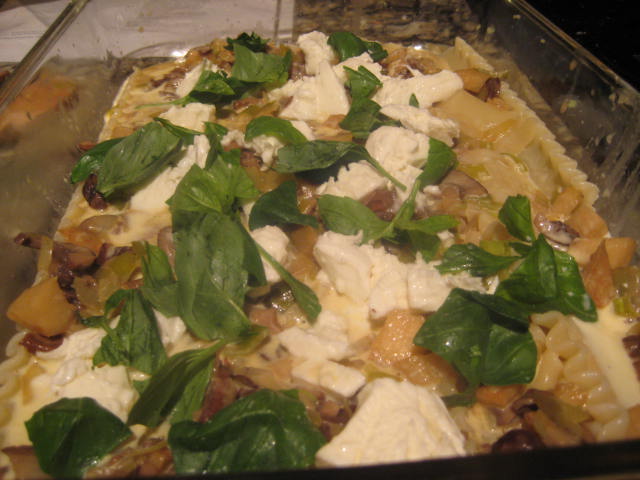
The recipe called for fresh basil and fresh mozzarella, in addition to the ragu and cream sauce.


And here it is, after an hour in the oven.  It's 11:07 p.m. and I'm eating my first piece and wow, was it worth the wait!